
There are less than 40 days to go before the start of Euro 2012, but instead of looking ahead, we are taking the opportunity to look back. Because when on the 8th of June Poland and Greece kick-off the tournament, most people will have all but forgotten about what went before.
Over a period of almost two years the participating teams fought out a tense qualification campaign, mixed up with a series of friendlies to improve form. Few of us, however, have followed the matches close enough to get a good overview of which team played at which stadiums. Did Italy play its home matches at the Stadio Olimpico or San Siro? How many venues did Portugal use in its campaign? Did England really only play at Wembley Stadium? We will tell you the answers.
Let’s start with a chart. The pie chart on the left shows the venues used in the qualification campaign. The pie on the right the venues used in all matches, so including friendlies. The slices are the venues, the number is the number of matches at each venue (which also determines the size of the slices). Our analysis follows below.
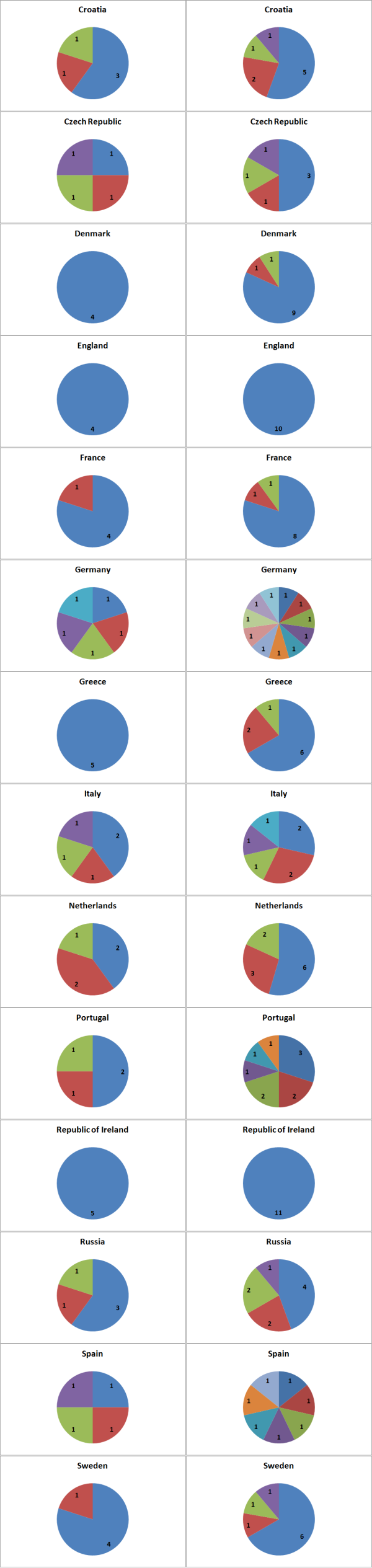
Let’s first take Portugal as an example to further clarify the chart. In their qualifying campaign (left column) they have played at three different stadiums. Two matches were played at Estádio do Dragão, one at Estádio da Luz, and one at Estádio D. Afonso Henriques.
Portugal furthermore played another six friendlies at home, two at Estádio da Luz (so three matches in total), two at Estádio Municipal de Leiria, and the other two in Aveiro and Faro. This all results in the distribution as seen in the chart in the second column.
If we take a high-level look at all the charts, we can distinguish two extremes: countries that play all their matches at one venue, and countries that operate a rotating policy.
Countries that heavily rely on one stadium are England (Wembley Stadium), Ireland (Aviva Stadium), Denmark (Parken), France (Stade de France), Greece (Karaiskakis Stadium), and Sweden (Råsunda Stadium). Some of these countries allocate a few friendlies to smaller stadiums (e.g. Greece and Sweden), others don’t (England and Ireland).
Allocating all matches to one stadium makes of course sense if the football association owns that stadium. After all, the English and Irish FA have to earn back the money they invested in the construction of their recently built stadiums. In other cases, such as Denmark and Greece, the choice may merely be a matter of the stadium being the best match in terms of expected attendances and facilities needed.
On the other extreme we have the rotators, most notably Germany and Spain, and to a lesser extent Italy and Portugal. But apart from using a rotating policy, there is little that Germany and Spain have in common.
Germany, lacking a national stadium, operates an official rotating policy that gives all large stadiums in the country the chance to host matches of the national team. The national team is popular, hence the relatively large number of home friendlies (6). We see a similar large number of home friendlies in other countries where the national team is popular such as England, Denmark, and the Netherlands.
In Spain, on the other hand, the national team fails to attract big crowds – even after their World Cup win – and internationals are therefore typically rotated amongst the smaller stadiums of the country, often in Segunda División cities. We see a similar pattern in Italy. Stadiums that have been used in the past two years by these two countries include Estadio de Los Cármenes (Granada) Estadio José Rico Pérez (Alicante), Estadio La Rosaleda (Málaga), Stadio Artemio Franchi (Florence), Stadio Alberto Braglia (Modena), and Stadio San Nicola (Bari).
Both countries have also played relatively few friendlies at home, with Spain having monetised its successes in countries such as Costa Rica and Venezuela, and Italy regularly playing at neutral soil such as in Austria or Switzerland. The exception is the odd high-profile friendly when the football associations do refer back to a Bernabéu or Olimpico.
Portugal relies a little more on a few flagship venues (Estádio da Luz and Dragão), but also puts its Euro 2004 venues to good use by letting them host friendlies.
Then there are the countries that hover somewhat in between these extremes. The Netherlands and Russia, for example, rely on a few large stadiums (with the Amsterdam ArenA and Luzhniki a touch more popular). The Czech Republic and Croatia are harder to categorise, but seem to rely on one larger stadium (Generali Arena and Stadion Maksimir) with some rotating with smaller stadiums.
The question, of course, is whether one approach is better than the other. Those in favour of rotating might argue that citizens of every part of the country should have the chance to see their national team. Others may say that internationals are the perfect opportunity to showcase the country and should therefore offer the best and largest stadium there is.
How do you feel about the policies of your country?
* Note: the friendlies include the ones still to be played in May and June in preparation of the Euros. We have left Poland and the Ukraine out of the analysis as they have primarily been testing their new venues.
Photos: © Flickr user Nicolas Babaian